

Hi, I'm Sarah Mitchell. I've spent years researching metabolic health to help women reclaim their energy and balance their hormones naturally. Welcome to BioHealth Source.
You just received a prediabetes diagnosis. Or maybe you’ve been tracking your blood sugar and you know your numbers are higher than they should be. Either way, you’re probably asking the same question everyone asks at this moment:
“What do I eat tomorrow?”
Not next month. Not after reading ten more articles. Tomorrow morning.
This 7-day prediabetes meal plan answers that question — clearly, practically, and without asking you to give up everything you enjoy. Every meal is built around the three pillars of blood sugar control: fiber first, quality protein, and smart carbohydrates. Every day follows the 9-Inch Plate Rule: 50% non-starchy vegetables, 25% lean protein, and 25% low-glycemic carbohydrates.
This is not a diet. It’s a roadmap.
Before diving in, if you haven’t yet read our guide on prediabetes symptoms, start there — understanding what’s happening in your body makes every food choice in this plan more meaningful. And for the science behind why each food was chosen, our prediabetes diet guide covers every principle in depth.
The 9-Inch Plate Rule — Your Daily Blueprint
Every meal in this 7-day prediabetes meal plan follows the same structural blueprint:
- 50% of your plate — Non-starchy vegetables, eaten first (the fiber-first rule)
- 25% of your plate — Lean protein or fatty fish
- 25% of your plate — Low-glycemic carbohydrates, eaten last
- Add — A drizzle of olive oil, avocado, or a small handful of nuts
This structure — combined with eating your vegetables before your carbohydrates — reduces post-meal blood sugar spikes by up to 73%, according to research published in Diabetes Care. For a complete breakdown of why food order matters so much, read our guide on blood sugar after eating.
The 7-Day Prediabetes Meal Plan
Monday: Kickstart with Protein
Breakfast: Greek yogurt parfait with 1/2 cup blueberries, 1 tbsp chia seeds, and a handful of walnuts.
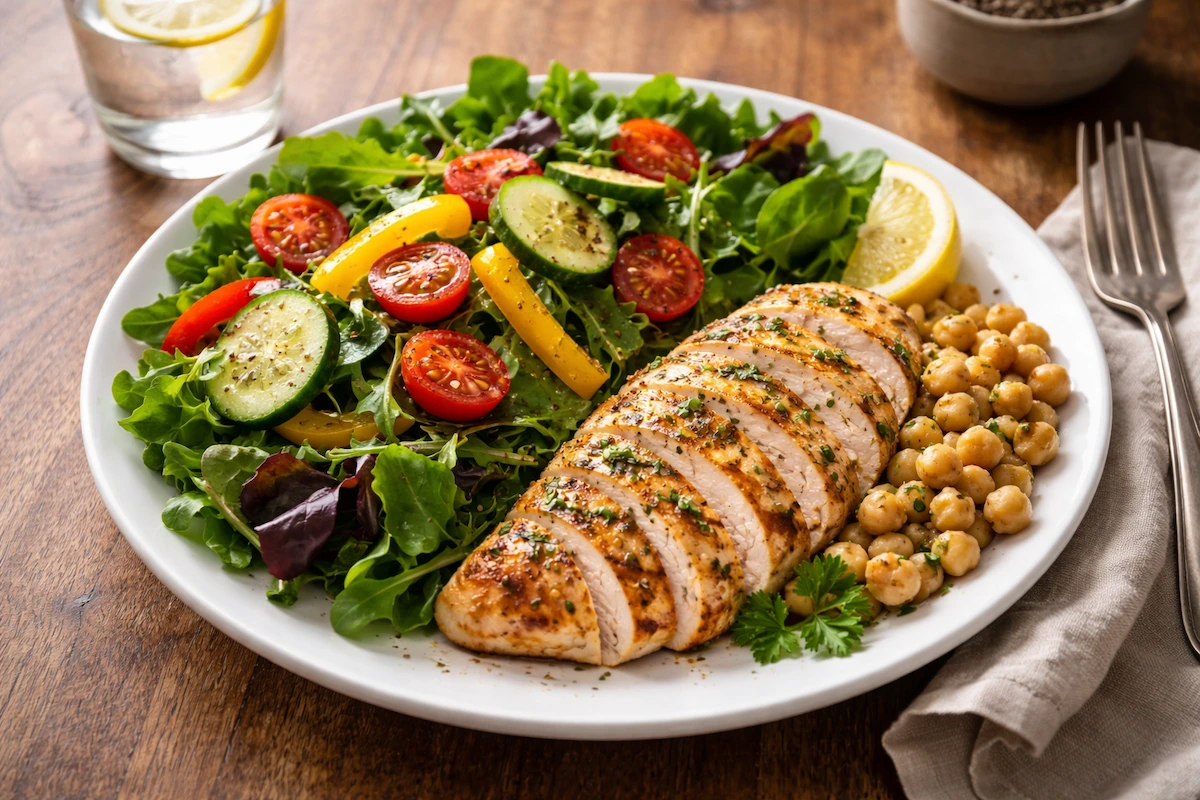
Lunch: Grilled chicken salad (4oz) with mixed greens, cucumber, bell peppers, and 1/4 cup chickpeas. Dressing: olive oil and lemon. Start with the salad before the chicken.
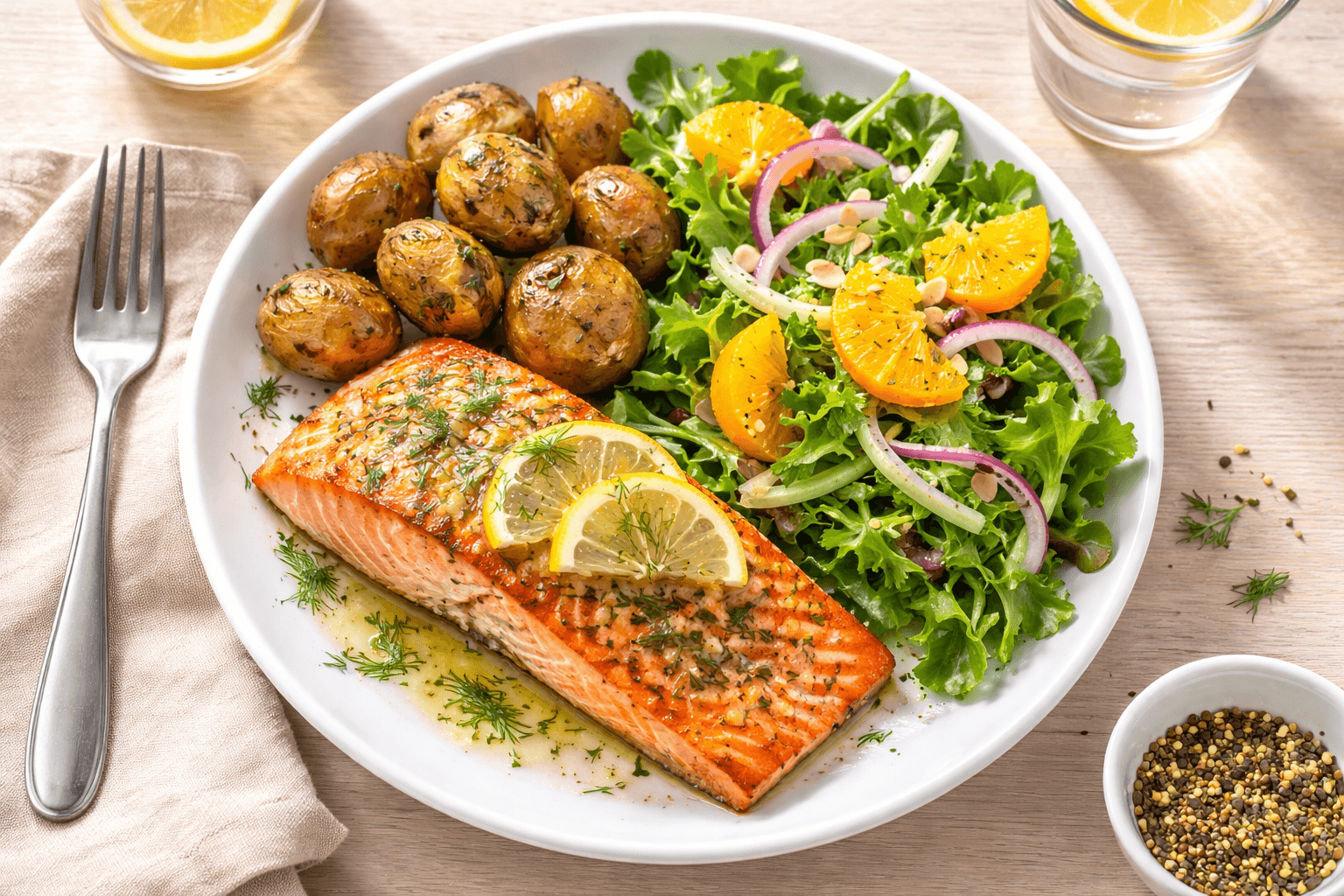
Dinner: Baked salmon with pesto, 1/2 cup roasted sweet potatoes, and steamed broccoli. Eat the broccoli first.
Snack: A small handful of raw almonds.
Why it works: Monday is anchored in complete protein — Greek yogurt, chicken, and salmon — to activate the anchor effect we covered in our guide on the best protein sources for blood sugar. The chickpeas add plant-based protein and fiber to the lunch, keeping post-meal glucose exceptionally flat.
Tuesday: Mediterranean Focus
Breakfast: 2-egg omelet with spinach and mushrooms + 1 slice of whole-grain toast (high fiber).
Lunch: Leftover salmon from Monday broken over a large green salad with avocado. Zero cooking required.
Dinner: Turkey meatballs with zucchini noodles (zoodles) and marinara sauce (no sugar added). Start with a side salad.
Snack: Celery sticks with almond butter.
Why it works: Tuesday follows the Mediterranean dietary pattern — one of the most consistently evidence-backed approaches for insulin resistance. The leftover salmon lunch is a built-in meal prep win that reduces decision fatigue mid-week.
Wednesday: Plant-Based Balance
Breakfast: Steel-cut oats (1/2 cup cooked) topped with cinnamon and 1 tbsp almond butter.
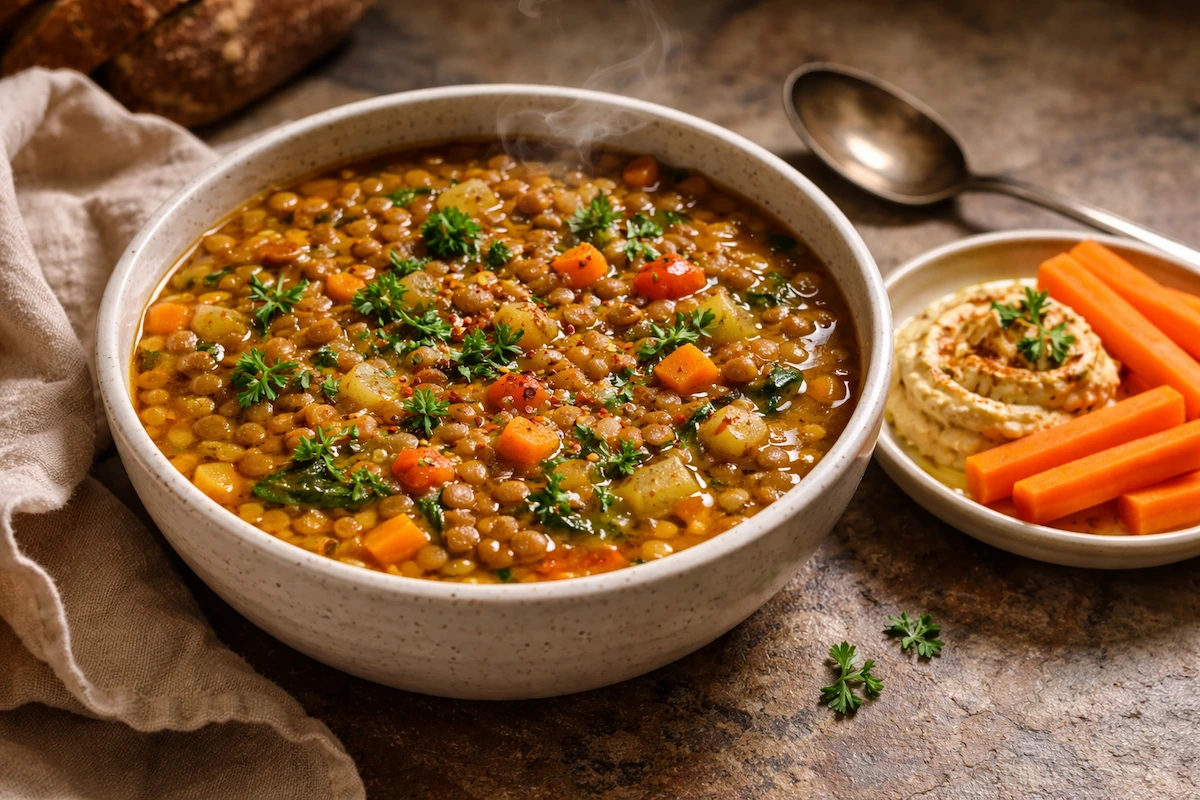
Lunch: Lentil and vegetable soup + a side of raw carrot sticks and hummus. Eat the soup first.
Dinner: Beef stir-fry with colorful bell peppers, snap peas, and onions served over 1/2 cup cauliflower rice.
Snack: One hard-boiled egg.
Why it works: Wednesday showcases the power of legumes — lentils have a glycemic index of just 32, making them one of the best low-glycemic carbohydrates available. Steel-cut oats (GI 55) are dramatically better than instant oatmeal (GI 83). For a full breakdown of why these choices matter, read our guide on the best low-glycemic carbohydrates.
Thursday: Smart Swaps
Breakfast: 1/2 cup cottage cheese with sliced strawberries and 1 tbsp flax seeds.
Lunch: Whole-grain wrap with turkey breast, avocado, and sprouts.
Dinner: Grilled white fish (cod or tilapia) with asparagus and 1/2 cup cooked quinoa. Eat the asparagus first.
Snack: A small piece of dark chocolate (85%+ cocoa).
Why it works: Thursday demonstrates smart swapping — cottage cheese instead of flavored yogurt, whole-grain wrap instead of white bread, cauliflower rice instead of regular rice. These swaps require no additional cooking time but produce dramatically different blood sugar responses.
Friday: Quick & Easy
Breakfast: Smoothie with 1 scoop unsweetened protein powder, 1 cup spinach, 1/2 small banana, and unsweetened almond milk.
Lunch: Tuna salad (made with Greek yogurt instead of mayo) served in lettuce cups.
Dinner: Roasted chicken breast with Brussels sprouts and a small side salad. Start with the salad.
Snack: Walnuts and a few blueberries.
Why it works: Friday is designed for busy end-of-week schedules — every meal takes under 15 minutes to prepare. The tuna salad with Greek yogurt swap eliminates the inflammatory fats in regular mayo while adding protein. Canned tuna is one of the most affordable and convenient sources of complete protein in this entire 7-day prediabetes meal plan.
Saturday: Weekend Variety
Breakfast: Scrambled eggs with tomatoes and feta + 1/4 avocado.
Lunch: Quinoa bowl with black beans, roasted peppers, and grilled shrimp.
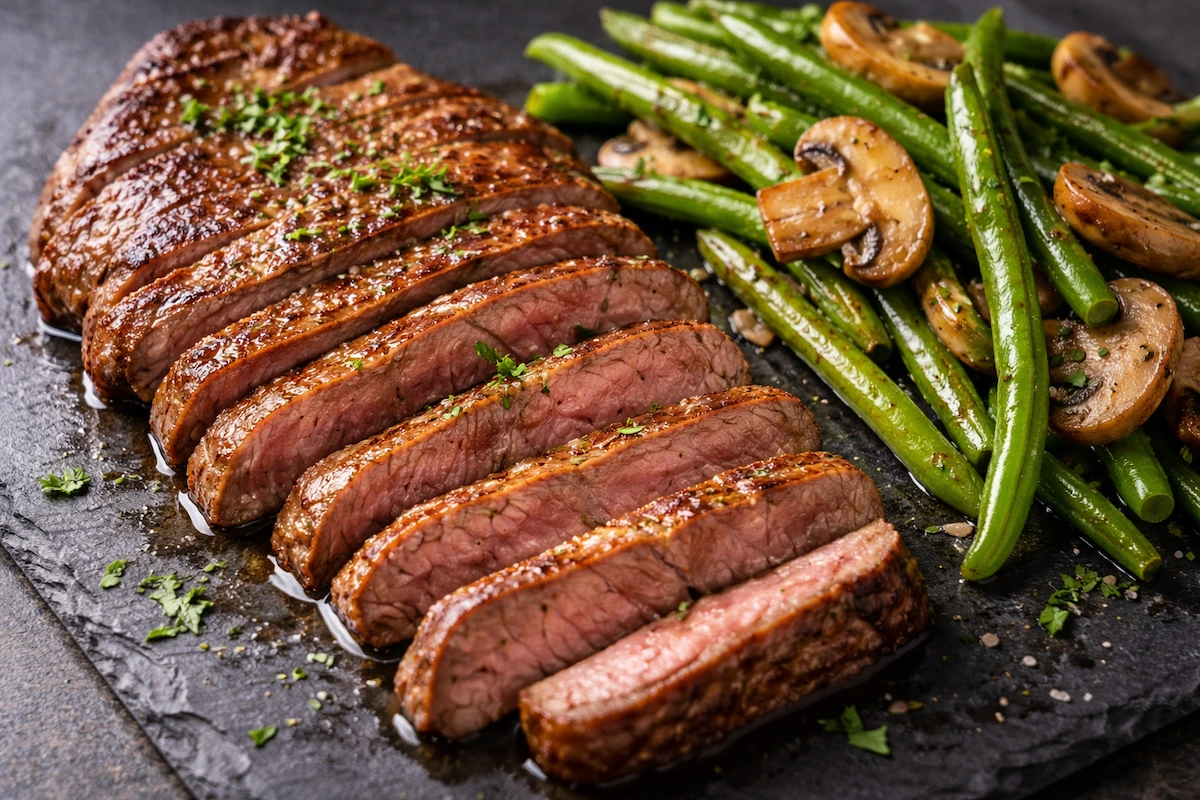
Dinner: Lean steak (sirloin or flank) with sautéed green beans and mushrooms. Start with the green beans.
Snack: Half a cup of mixed berries.
Why it works: Saturday brings variety and satisfaction — because sustainability is everything in a prediabetes meal plan. The quinoa bowl combines complete protein (quinoa + shrimp) with the fiber of black beans and peppers, producing a very flat post-meal glucose curve despite being a satisfying, flavorful meal.
Sunday: Prep Day

Breakfast: Almond flour pancakes topped with a few fresh raspberries.
Lunch: Ground turkey stir-fry with cabbage and ginger (make extra — it’s Monday’s lunch).
Dinner: Roasted chicken with roasted cauliflower. (Save the leftovers for Monday’s lunch!)
Snack: Pumpkin seeds.
Why it works: Sunday is your metabolic reset and prep day. The roasted chicken and ground turkey stir-fry are intentional — their leftovers become Monday’s lunch, setting you up for a strong start to week two.
Sunday Night Reminder: How well you sleep tonight directly determines your fasting blood sugar tomorrow morning. Cortisol follows a strict circadian rhythm — staying up late on Sunday raises cortisol, which raises your Monday morning fasting glucose. For the full explanation, read our guide on how stress and cortisol affect blood sugar.
Your Prediabetes Grocery List — The Essential 10
Everything in this 7-day prediabetes meal plan was chosen with one goal: to keep your blood sugar stable without making your life complicated.
Print this list before your next grocery run. Everything you need for the full 7-day prediabetes meal plan, organized by category:
Proteins
- Chicken breast (boneless, skinless)
- Eggs (1 dozen)
- Salmon fillets (fresh or frozen)
- Canned tuna (in water)
- Ground turkey
- Greek yogurt (plain, unsweetened)
- Cottage cheese
Vegetables
- Spinach and mixed greens
- Broccoli
- Bell peppers (mixed colors)
- Zucchini
- Brussels sprouts
- Asparagus
- Cauliflower
- Mushrooms
- Celery and carrot sticks
Healthy Fats
- Avocados (3-4)
- Extra virgin olive oil
- Raw almonds and walnuts
- Almond butter
- Flax seeds and chia seeds
Smart Carbohydrates
- Quinoa
- Sweet potatoes (2-3)
- Steel-cut oats
- Lentils (dried or canned)
- Chickpeas (canned)
- Black beans (canned)
- Whole-grain wraps or bread (high fiber)
- Almond flour
Fruits
- Blueberries (fresh or frozen)
- Strawberries
- Raspberries
- 1 banana (for the smoothie)
Pantry Staples
- Unsweetened almond milk
- Unsweetened protein powder
- Pesto (store-bought, no sugar added)
- Marinara sauce (no sugar added)
- Dark chocolate (85%+ cocoa)
- Pumpkin seeds
- Cinnamon
Budget-Friendly Swaps — Same Results, Lower Cost
Following a 7-day prediabetes meal plan doesn’t have to strain your budget. Every expensive ingredient in this plan has an equally effective, more affordable alternative — with the same protein content, fiber, and blood sugar benefits.
Protein Swaps
Salmon fillets → Canned salmon or sardines Canned salmon and sardines deliver the same omega-3 fatty acids and complete protein as fresh fillets — at a fraction of the cost. Sardines in olive oil are particularly rich in omega-3s and require zero preparation. Nutritionally identical to fresh salmon for blood sugar purposes.
Shrimp → Canned tuna or eggs Canned tuna in water provides 25 grams of complete protein per can — one of the most affordable high-protein options available. Eggs are the most accessible complete protein source available, with zero glycemic impact and endless preparation options.
Sirloin or flank steak → 93% lean ground beef 93% lean ground beef delivers the same complete amino acid profile as steak at a significantly lower cost. Season with garlic, cumin, and black pepper for a satisfying, metabolically identical substitute in stir-fries and bowls.
Carbohydrate Swaps
Quinoa → Barley or brown rice (cooled) Pearl barley has a glycemic index of just 28 — even lower than quinoa (GI 53) — and costs significantly less. Brown rice, when cooked and cooled overnight (the temperature trick from our <a href=”https://biohealthsource.com/best-low-glycemic-carbohydrates/”>low-glycemic carbohydrates guide</a>), develops resistant starch that dramatically lowers its blood sugar impact.
Almond flour pancakes → Steel-cut oat pancakes Almond flour is expensive. Steel-cut oats blended into a fine flour and mixed with 2 eggs and a splash of almond milk make equally satisfying pancakes with a GI of 55 — far lower than regular flour pancakes — at a fraction of the cost.
Fresh berries → Frozen berries Frozen blueberries, strawberries, and raspberries are nutritionally identical to fresh — same fiber, same antioxidants, same low glycemic index. They’re often cheaper than fresh and available year-round. This is one of the smartest swaps in the entire prediabetes meal plan.
Fat and Nut Swaps
Raw almonds → Sunflower seeds or peanuts Sunflower seeds provide 6 grams of protein and 3 grams of fiber per ounce — comparable to almonds — at roughly half the cost. Natural peanut butter (no added sugar) is one of the most affordable healthy fat sources available, with 8 grams of protein per 2 tablespoons.
Almond butter → Natural peanut butter Natural peanut butter — ingredients: peanuts and salt only — delivers the same healthy fat profile and satiety as almond butter at roughly 30% of the cost. Check the label: avoid any peanut butter with added sugar or hydrogenated oils.
Dairy Swaps
Greek yogurt (name brand) → Store-brand plain yogurt, strained Place regular plain yogurt in a cheesecloth or fine strainer over a bowl in the refrigerator for 2 to 4 hours. The whey drains out, leaving a thick, creamy yogurt with the same protein content as Greek yogurt — at half the price.
Cottage cheese (full-fat) → Ricotta cheese Full-fat ricotta has a similar protein and fat profile to cottage cheese, often at a lower price point. Mix with berries and flax seeds for an equally satisfying breakfast.
The Budget Prediabetes Meal Plan — Core Shopping List
If cost is a primary concern, these 10 items form the most affordable foundation for this entire 7-day prediabetes meal plan:
- Eggs — the most affordable complete protein available
- Canned tuna and sardines — omega-3 protein under $2 per serving
- 93% lean ground beef or chicken thighs — cheaper than breast, same protein
- Dried lentils and black beans — cook in bulk, freeze in portions
- Frozen spinach and frozen broccoli — same nutrition as fresh, longer shelf life
- Frozen mixed berries — identical nutrition to fresh at lower cost
- Steel-cut oats — buy in bulk for maximum savings
- Sweet potatoes — one of the cheapest low-glycemic carbohydrates available
- Natural peanut butter — affordable healthy fat and protein
- Store-brand plain yogurt — strain at home for Greek yogurt equivalent
The Golden Rules for This 7-Day Prediabetes Meal Plan
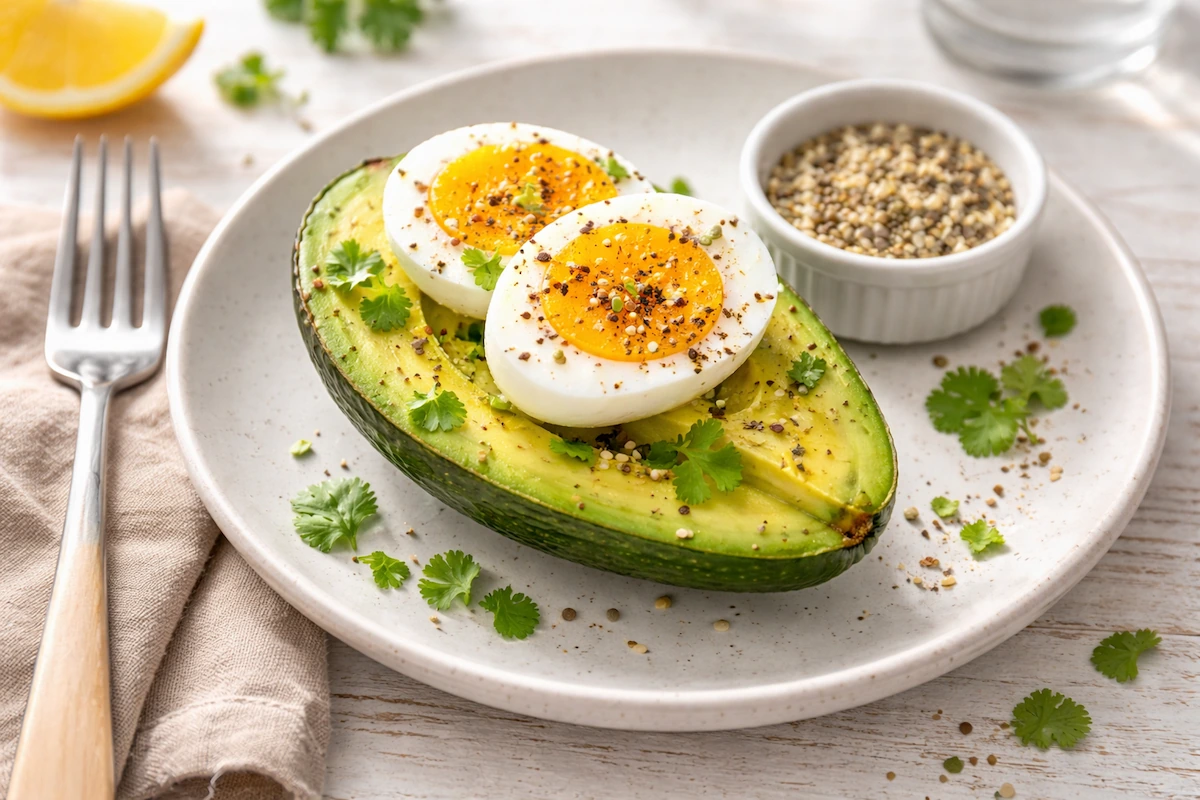
Before you start, commit to these four rules — they make the difference between good results and great results:
Rule 1 — Vegetables always come first. At every lunch and dinner, eat your non-starchy vegetables before anything else on your plate. This single habit can reduce post-meal glucose spikes by up to 73%.
Rule 2 — No liquid sugar. Water, unsweetened tea, and black coffee only. No sodas, fruit juices, or sweetened drinks. This is the single most impactful change most people can make immediately.
Rule 3 — Walk after dinner. A 10-minute walk within 30 minutes of finishing dinner activates your muscles to absorb glucose directly — flattening your post-meal glucose curve in real time. Read our complete guide on walking after meals benefits.
Rule 4 — Sleep is part of the plan. Your fasting blood sugar tomorrow reflects how well you sleep tonight. Prioritize 7 to 9 hours consistently. For why this matters metabolically, read our guide on blood sugar when fasting.
What to Expect — Week by Week
Days 1-3: You may notice increased energy after meals as post-meal glucose spikes flatten. Some people experience mild carbohydrate cravings as their blood sugar stabilizes — this is normal and typically resolves within 3 to 5 days.
Days 4-7: Most people report significantly more stable afternoon energy, reduced post-meal fatigue, and improved sleep quality by the end of the first week. Many also notice reduced sugar cravings — a direct reflection of more stable blood sugar.
After Week 1: Fasting blood sugar improvements typically become measurable within 2 to 4 weeks of consistent practice. Track your fasting numbers each morning to see your progress. For guidance on what your fasting numbers should look like, read our guide on blood sugar when fasting.
Frequently Asked Questions
Can I repeat meals I enjoy instead of following the plan exactly?
Absolutely. The 7-day prediabetes meal plan is a template, not a strict prescription. If you love the Monday salmon dinner, have it on Wednesday too. The principles matter more than the exact meals — fiber first, quality protein, low-glycemic carbohydrates last.
What if my blood sugar is still high in the morning despite following this plan?
Morning fasting blood sugar is influenced by more than just what you eat. Stress, sleep quality, and the Dawn Phenomenon all affect your fasting numbers independently of diet. If your numbers are still elevated despite following this plan, read our guide on how stress and cortisol affect blood sugar — it may hold the missing piece.
Are there vegetarian options for this plan?
Yes — most meals can be adapted easily. Replace chicken and fish with lentils, chickpeas, tofu, or tempeh in equal portions. The Wednesday plant-based day is already fully vegetarian and can serve as a template for adapting other days.
Can I add snacks beyond those listed?
Yes — the best blood-sugar-friendly snacks are those combining protein and healthy fat with minimal carbohydrates: a hard-boiled egg, raw nuts, cottage cheese, celery with almond butter, or a small piece of dark chocolate (85%+).
How does this plan differ from the prediabetes diet guide?
Our prediabetes diet guide covers the principles and rules in depth. This post is your practical, day-by-day implementation — the roadmap you follow when you’re standing in the kitchen wondering what to cook. Use both together for the best results.
The Bottom Line
A prediabetes diagnosis is not a verdict. It’s an invitation — to make smarter choices, to understand how food affects your body, and to take back control before things progress further.
This 7-day prediabetes meal plan gives you the roadmap. The grocery list gives you the tools. The golden rules give you the framework. Everything else is consistency.
Start with Monday’s breakfast. That’s all. One Greek yogurt parfait with blueberries and walnuts. And then the next meal. And the next.
Small, consistent actions compound into real metabolic transformation — and this 7-day prediabetes meal plan is exactly where that transformation begins.
“The most common thing I hear from people after a prediabetes diagnosis is ‘I don’t know what to eat.’ That paralysis is real — and it’s exactly what this plan is designed to break. You don’t need to be perfect. You need to start. Print the grocery list, follow Monday’s meals, and take a 10-minute walk after dinner. That’s day one. Day one leads to day seven. Day seven leads to real change in your numbers.”
— Sarah Mitchell
📚 Scientific References
American Diabetes Association (ADA): Eating Healthy & Meal Planning. Practical guidelines on creating balanced meal plans with lean proteins and non-starchy vegetables.
Harvard T.H. Chan School of Public Health: Carbohydrates and Blood Sugar. Detailed insights on how the Glycemic Index (GI) of carbohydrates affects insulin and blood glucose levels.
National Institute of Diabetes and Digestive and Kidney Diseases (NIDDK): Diabetes Diet, Eating, & Physical Activity. A comprehensive resource on balancing food groups and portion sizes to manage daily glucose readings.
Mayo Clinic: Diabetes diet: Create your healthy-eating plan. Guidance on the “Diabetes Plate Method” for optimizing fiber intake and slowing sugar absorption.
Cleveland Clinic: How to Follow a Low-Glycemic Index Diet. A practical guide on choosing low-GI foods like beans and leafy greens to prevent insulin spikes.
Medical Disclaimer: The information provided on BioHealth Source is for educational and informational purposes only and does not constitute medical advice. Always consult with a qualified healthcare professional before making significant changes to your diet, exercise routine, or if you have questions regarding a medical condition.
Affiliate Disclosure: This post may contain affiliate links. If you click on one of these links and make a purchase, we may receive a small commission at no extra cost to you. This helps support our research and content creation. We only recommend products we truly believe in.